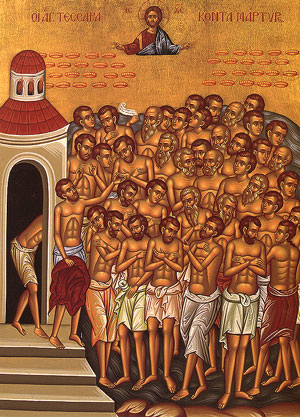
3rd Week of Lent, Tuesday, Mar 10; The Forty Martyrs of Sebaste
3rd Week of Lent, Tuesday, Mar 10; The Forty Martyrs of Sebaste
Daniel 3:25, 34-43 / Matthew 18:21-35
Jesus speaks about forgiveness; "Forgive seventy-seven times."
Tommy Pigage was drunk when he hit and killed Ted Morris of Kentucky. Ted was the only son of Mrs. Elizabeth Morris. The death of her only son left Elizabeth stunned and angry. Tommy pleaded guilty, was convicted, and was ordered to give talks to high school students on behalf Of MADD (Mothers Against Drunk Drivers) One day Elizabeth went to hear Tommy speak. She heard him say with heartfelt emotion that he "murdered Ted” and should be behind bars for what he did. Elizabeth said, "I didn't want my son's death to be totally in vain. And, in my heart, I knew that if he could, Ted would tell us to forgive Tommy.” Today Elizabeth and Tommy are friends.
****
How forgiving are we toward others? "They who forgive most will be most forgiven." Joseph W Baily
****
We don’t like too much—or not at all—to acknowledge it, but we have been forgiven a lot. Open, scandalous, upsetting sins... maybe not. Probably not. But scandalous in the sense of totally unexpected on the part of people who profess to be the sign of the Church, of Christ, of God... perhaps yes: antipathies, non-sharing, animosities, enmities nurtured for years, living side-by-side without genuine love and sharing, maybe yes... and to many or at least some the opposite of witnessing to what we profess to be, yes... Where is our forgiving others as God has forgiven us, as we pray in the Lord’s Prayer?
***
A man lay on his death bed. Having held public office, though never any major ones, he had experienced how a politician's motives and actions are open to the sometimes-erroneous judgment of others. Despite his good intentions, he had made many enemies. After his confession, he said to the priest, "Father, I am grateful for one thing, that I will be judged by God and not by my fellow men."
The dying man had a point. Though we may fear to stand before God as our judge, we must remember that God is not only infinitely wise and powerful, but also infinitely merciful. His mercy exceeds any mercy a human being could possibly manifest. Notice in today's parable a detail you may have overlooked. The official, who owed the huge amount, pleaded with the master only for a delay; he said, "My lord, be patient with me and I will pay you back in full." The master not only heeded the plea but granted even more than the official dared ask: "Moved with pity, the master let the official go and wrote off the debt."
The master of course represents God, who wishes to write off our debt of sin completely, but he will do so only if we learn to forgive those who have offended us. When our brother has wronged us, how often must we forgive him? Jesus says, "Seventy times seven times," that is, without any limit. When we are tempted to feel that enough is enough, maybe it will help to remember that any injury done us is trifling in comparison with the sins we have committed against God, as the gospel says, a mere fraction. Like the dying man, we too can be grateful that we be judged by God, but only if we have learned to forgive our brothers without limit from our heart.
****
Prayer
Lord our God, we consider ourselves your chosen flock, the people who profess to be your sign of reconciliation. God, how poor we are! How often we fail you by forgiving by an act of condescension, as if we did a great favor to those who sought to be reconciled with us. Lord, help us to forgive the way and to the extent that you forgive us: unconditionally and totally, in the goodness of our hearts. Give us this greatness of heart through Jesus Christ our Lord. Amen.
****
The Forty Martyrs of Sebaste; Feast Day March 10
After 316, the emperor Licinius decreed a persecution of
Christians in the East. He threatened death if they failed to renounce their
faith. In 320, forty young Christian Roman soldiers refused to sacrifice to
idols and were tried before the tribunal at Sebaste, Cappadocia. The governor
tried threats, bribery, and torture to persuade the young men, but they stood
firm. He put the forty in prison, where it is said that Christ appeared and
encouraged them to persevere.
Incensed by the soldiers’ obstinacy, the governor ordered
that they be stripped and left to die standing on a frozen lake. He arranged a
fire and warm bath on the shore to tempt them to apostatize. All forty signed a
will, drafted by St. Meletius, the youngest, that expressed their faith, unity,
and courage:
When we by God’s grace and the common prayers of all shall
furnish the strife set before us, and come to the rewards of the high calling,
we desire that then this will of ours may be respected . . .For although we
come from different localities, we have chosen one and the same resting-place
because we have set before ourselves one common strife for the prize. These
things have seemed good to the Holy Spirit and have pleased us. Therefore we .
. . brothers in Christ beseech our honored parents and relatives to have no
grief or distress, but to respect the decision of our brotherly fellowship, and
to consent heartily to our wishes, so that you may receive from our common
Father the great recompense of obedience and of sharing in our sufferings. . .
.
We pray with our souls and with the Divine Spirit that we
may all obtain the eternal good things of God and his kingdom, now and forever
and ever. Amen.
The young men did not wait to be stripped, but removed their
clothes themselves. And together they prayed, “Lord, we are forty engaged in
this contest. Grant that forty may receive crowns and that we may not fall
short of that sacred number.” After one night’s ordeal, however, one soldier
caved, but died of extreme heat in the bath, losing his martyr’s crown. But an
off-duty guard, prompted by the martyrs’ courage and a dream, professed himself
a Christian and took his place, thus preserving their number.
After three days the governor had the survivors’ limbs
broken and their bodies burned. Officials hoped that young Meletius would save
himself, but his mother herself lifted him onto the wagon, not wanting him to
lose his prize. The governor had the ashes of the forty martyrs scattered into
a river, but Christians secured some that became treasured relics, inspiring
many throughout the Middle Ages.
The young martyrs of Sebaste have fascinated me since my
youth. And their idealism and brotherhood may also intrigue today’s young
people and invite them to consider seriously a commitment to Christ. “Young
people,” says jour- nalist Paul Lauer, “have enough energy to climb tall
mountains of faith, hope, and love. If all we offer them are little molehills,
they’ll simply go elsewhere for their challenges.”